Showing posts with label rkuipers. Show all posts

Seeking Stillness or The Sound of Wings: Scholarly and Artistic Comment on Art, Truth, and Society in Honour of Lambert Zuidervaart

Seeking Stillness or The Sound of Wings: Scholarly and Artistic Comment on Art, Truth, and Society in Honour of Lambert Zuidervaart. Currents in Reformational Thought series. Edited by Héctor Acero Ferrer, Michael DeMoor, Peter Enneson and Matthew Klaassen; cover art by Joyce Recker (small wooden house in foreground with a nest of twigs inside and gnarly sticks protruding through the roof into the slightly cloudy blue sky)
Seeking Stillness or The Sound of Wings: Scholarly and Artistic Comment on Art, Truth, and Society in Honour of Lambert Zuidervaart
Currents in Reformational Thought series. Edited by Héctor Acero FerrerMichael DeMoorPeter Enneson and Matthew Klaassen. Eugene: Wipf and Stock, 2021.


Publisher's Overview:

Seeking Stillness or The Sound of Wings pays tribute to Lambert Zuidervaart, one of the most productive Reformational philosophers of the present generation, by picking up the central concerns of his philosophical work--art, truth, and society--and working with the legacy of his published concern to see what more can be understood about our world in light of that legacy. Zuidervaart is an internationally recognized expert in critical theory, especially the work of Theodor Adorno, and a leading systematic philosopher in the reformational tradition. His research and teaching range across continental philosophy, epistemology, social philosophy, and philosophy of art, with an emphasis on Kant, Hegel, Marx, Heidegger, Gadamer, and Habermas. He is currently developing a new conception of truth for an allegedly post-truth society. At the Institute for Christian Studies (2002-2016), Zuidervaart held the Herman Dooyeweerd Chair in Social and Political Philosophy and served as founding Director of the Centre for Philosophy, Religion, and Social Ethics. He was also an Associate Member of the Graduate Faculty and Full Professor, status only, in the Department of Philosophy at the University of Toronto, and a member of the Advanced Degree Faculty at the Toronto School of Theology. Zuidervaart is currently a Visiting Scholar in the Department of Philosophy at Calvin University in Grand Rapids, Michigan. Seeking Stillness or The Sound of Wings seeks to promote new scholarship emerging from the rich and dynamic tradition of reformational intellectual inquiry. Believing that all scholarly endeavor is rooted in and oriented by deep spiritual commitments, reformational scholarship seeks to add its unique Christian voice to discussions about leading questions of life and society. From this source, it seeks to contribute to the redemptive transformation and renewal of the various aspects of contemporary society, developing currents of thought that open human imagination to alternative future possibilities that may helpfully address the damage we find in present reality. 

As part of this work, Currents in Reformational Thought will bring to light the inter-and multi-disciplinary dimensions of this intellectual tradition, and promote reformational scholarship that intentionally invites dialogue with other traditions or streams of thought.

Contributors:

Janet Wesselius
Shannon Hoff
Allyson Carr
Nicholas Wolterstorff
Henry Luttikhuizen
Lauren Bialystok
Karen Nisenbaum
Martin Jay
Clarence Joldersma

Artistic Contributors:

Joyce Recker
Michaeleen Kelly
Linda Nemec Foster
Sue Sinclair
Diane Zeeuw
Deborah Rockman
Jay Constantine
Ron and Miriam Pederson
Janet Read

Graduates and Undergraduates Talk God and Politics in 2019 Workshop and Joint Course

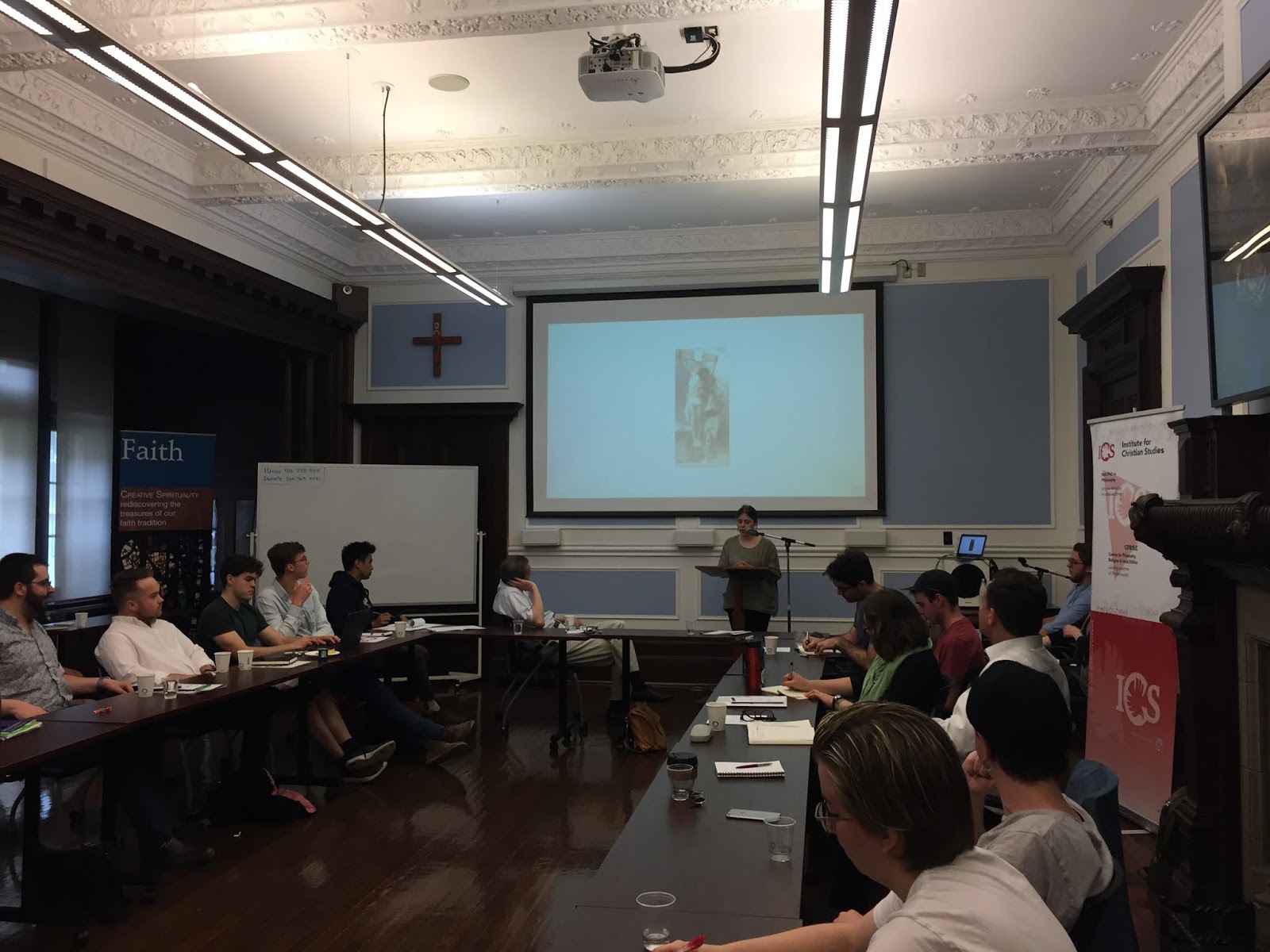
On May 23-25, 2019 ICS hosted its third annual Undergraduate Workshop that invited undergraduate students from all over to join us in Toronto and to get a taste of graduate education. This year, we were joined by ten undergraduate presenters from the following institutions in Canada, the U.S., and Qatar: Greenville University, Canadian Mennonite University, Cornerstone University, The King's University, Memorial University Newfoundland, and Georgetown University in Qatar. 


Undergraduate participants presented their own research
to the group and fielded questions
These students presented their own academic research as it related to the theme of this year's workshop: God & Politics: Religion and Public Life in the 21st Century. Paper topics ranged from a deep engagement with Indigenous writers thinking about the practice and possibility of "nation-to-nation" sovereignty in Canada today to a historical narrative study of the work and life of Saint Oscar Romero from El Salvador; from a critical study of the Minjung liberation theology movement in Korea to a thorough exploration of Immanuel Kant's reading of the ethical and moral implications of the story of Abraham and Isaac. 

Dr. Ronald A. Kuipers welcoming everyone
to the workshop
The undergraduates' papers received formal responses from ICS Senior Members, Junior Members, and alumni, with each response being followed by extensive group discussion. Each of the undergraduates displayed a remarkable depth of research ability and an admirable aptitude to respond to hard-hitting questions. ICS was proud to host these talented students and wishes each of them well in their ongoing academic work.

The Workshop occurred in conjunction with another undergraduate-graduate joint event: a summer intensive course titled “To the Unknown God”: Paul and Some Philosophers. ICS and The King's University joined together to offer this course, which included a preparatory reading portion, participation in the Workshop, and an intensive one-week in-class portion following the Workshop. During the course, students read a number of philosophers who consider the writings of the Apostle Paul and their relevance to contemporary political questions. The course was led by ICS President and Senior Member in Philosophy of Religion Dr. Ronald A. Kuipers and King's Professor of Philosophy Dr. Jeffrey Dudiak.


Dr. Jeffrey Dudiak introducing prevalent themes
for the workshop and course
Outside of class time, students explored the new ICS location, the University of Toronto campus, and the city of Toronto. King’s alum and ICS Board Member Lynnette Postuma also hosted a dinner with students and professors to celebrate the joint efforts of the two universities to offer this engaging course in Toronto. We at ICS are thankful for the chance to work alongside The King's University, and for the participation of the students who took up the challenge with aplomb, and we look forward to future shared learning opportunities like this one.


Visiting course participants enjoying a dinner hosted by
King's alum and ICS Board member Lynnette Postuma

Course participants taking a tour of campus

Participants in the ICS-King's joint course
"To the Unknown God": Paul and Some Philosophers


----------
Both the Workshop and the course were graciously hosted at Regis College by the Msgr. John Mary Fraser Centre for Practical Theology. ICS would like to extend its thanks to both Regis and the Centre for their hospitality during these events.

ICS and King's to Offer Joint Workshop and Intensive Seminar on Paul


This May, ICS and The King's University will take an historic step in acting on their affiliation!

Both institutions will be offering their first joint course available to be taken for credit by both graduate and undergraduate students. ICS President and Senior Member Ronald A. Kuipers and King's professor of philosophy and ICS alumnus Jeffrey Dudiak will co-lead the seminar and workshop, which will occur on-site in Toronto over the course of the week of May 23-31, 2019.

The course is titled "To the Unknown God": Paul and Some Philosophers, and will consist of two parts: participation in this year's ICS Undergraduate Workshop—a presentation-based workshop driven by close interaction with contributing students' research—and a week-long intensive seminar. Students have the option of either applying to the workshop apart from participation in the seminar, or enrolling in the seminar, which includes participation in the workshop.

The workshop will allow undergraduate and graduate students to experience firsthand the kind of deep and careful attention to their ideas that is characteristic of both an ICS and King's approach to education. The intensive seminar around the current use of the thought of Paul in the realm of social and political philosophy will, in turn, allow them to engage deeply with current trends in the field and to make live connections to their own work, interests, and concerns.

We eagerly anticipate making this joint opportunity a reality for both institutions in the coming months. If you or anyone you know would be interested in participating in the seminar, the workshop, or both, please contact our Registrar at academic-registrar@icscanada.edu.

Opening Frames: Cinema and Transcendence

A Two-Day Conference on Film and Spirituality

April 3–4, 2017

TIFF Bell Lightbox, Green Room
350 King Street West, Toronto · map

Featuring cinematic legend Paul Schrader (Taxi Driver, Raging Bull, Affliction), speaking on the "Transcendental Style" in film

Other speakers include:

Schedule

Monday, 1:00pm–4:00pm
Registration (1:00) and Panel Discussion (2:00–4:00) with David Peck (moderator), Hugh Gibson, Sherien Barsoum, Paul Johansen, and Mark Kingwell

Keynote Speaker 7:00pm
Paul Schrader (with Joe Kickasola)

Tuesday, 10:00am–4:00pm
Workshop 1: Catherine Wheatley (10:30–12:00)
Workshop 2: Mark Cauchi, John Caruana (1:00–2:25)
Workshop 3: Joe Kickasola (2:35–4:00)


Register ($65 for both days)
Registration for Paul Schrader's lecture only can be done at the TIFF page for the lecture. (Note that on the linked page you must float your cursor over the event date and click on that in order to be taken to TIFF's Ticketmaster page, where you can then purchase tickets for the Schrader lecture.)


Presented through a partnership between TIFF, The Institute for Christian Studies' Centre for Philosophy, Religion, and Social Ethics, Ryerson University, and Imago.


Are We There Yet? Economic Justice and the Common Good

On May 12 & 13, 2014, The King’s University College and the Institute for Christian Studies co-hosted a conference on economic justice in Edmonton, Alberta, entitled Are We There Yet? Economic Justice and the Common Good.

• Watch Address by Dr. Bob Goudzwaard (YouTube)

• Watch Address by the Honourable Diane Ablonczy (YouTube)

• Jump to the Conference Archive

ICS conference organisation by the ICS Centre for Philosophy, Religion and Social Ethics (CPRSE). Ronald A. Kuipers, director of the CPRSE.

Richard Rorty Book Launch

Thomas E. Reynolds, Ronald A. Kuipers. 2013

Who's Afraid of Rorty? CPRSE Celebrates the Launch of Director Ronald A. Kuipers' Book on the Infamous American Philosopher, Richard Rorty.

• Watch on YouTube

Explore the latest volume in Bloomsbury Press' Contemporary American Thinkers Series, which Princeton's Jeffrey Stout describes as "a well-informed, interesting, and clear overview of Richard Rorty's contribution to American thought." Meet Rorty, the bad-boy of analytic philosophy, the liberal ironist, and the anticlerical prophet, on his mission to save Western thought from itself. Tom Reynolds of Emmanuel College provides opening reflections on the book, to which Kuipers' then responds.

Richard Rorty

Kuipers, Ronald A. Richard Rorty. New York: Bloomsbury Academic, 2013.

Find it on: Bloomsbury | Amazon | Indigo

Preview at: Google Books

Richard Rorty is one of the most oft-cited yet least understood philosophers of the twentieth century. This book offers an overview and introduction to Rorty's ideas, key writings and contributions to the various fields of philosophy. Chronologically organized, the book traces the development of Rorty's thought and examines all the key topics, and controversies, central to his work. Ronald A. Kuipers introduces Rorty’s complex thought through the exploration of three Rortyan personas: The Philosophical Therapist, The Liberal Ironist, and the Anticlerical Prophet. This exploration of Rorty’s multivalent yet deeply coherent intellectual identity is set against the background of Rorty’s personal motivations for studying philosophy, and for pursuing the controversial questions he did. The book portrays how, in conversation with the traditions of American Pragmatism, Analytic Philosophy, and Continental Thought, Rorty weaves his own unique and original philosophy. Rorty’s originality resides in his fresh approach to interrelated social and political problems, revealing a thinker who has important reasons for wading into controversial intellectual waters. This is the ideal companion to study of this hugely influential thinker.

Responses to the Enlightenment Book Launch

Hendrik Hart, William Sweet and Ronald Kuipers. 2012

Beyond Belief: CPRSE Launches Hendrik Hart and William Sweet's Responses to the Enlightenment: An Exchange on Foundations, Faith, and Community.

• Watch on YouTube

What is the role of reason in religion? What part should religious beliefs play in the life of faith? Is faith more than the sum of the religious beliefs that express it? Can religious language use be an occasion for, or must it always delimit, authentic religious experience? Explore these and other scintillating questions as CPRSE Director Ronald Kuipers leads off this boisterous exchange between three important and interesting philosophers of religion.

Imagination's Truths Art Talks! Event

Imagination's Truths: Re-envisioning Imagination in Philosophy, Religion and the Arts. Richard Kearney, Mark Knight, Ronald Kuipers, Anne Michaels and Rebekah Smick. 2012

• Watch on YouTube

Videos include an interview with and a lecture by Richard Kearney (Charles B. Seelig Chair of Philosophy, Boston College) and a panel discussion including Kearney plus Mark Knight (English, U. of T.), Ronald A. Kuipers (Phil. of Rel., ICS), Canadian writer Anne Michaels and Rebekah Smick (Phil. Of Arts & Culture, ICS) moderating.

The event was produced by the Centre for Philosophy, Religion and Social Ethics (CPRSE) in conjunction with Emmanuel College, in Toronto Canada, and took place on October 13, 2012.

Turning Memory into Prophecy: Paul Ricoeur and Roberto Unger on the Human Condition between Past and Future

Kuipers, Ronald A.. “Turning Memory into Prophecy: Paul Ricoeur and Roberto Unger on the Human Condition between Past and Future,” in The Heythrop Journal 52/2, 2011: 1-10.

In The Self Awakened: Pragmatism Unbound, Roberto Unger consistently maintains that, in any democracy worthy of the name, ‘prophecy’ ought to speak louder than ‘memory’. Precisely what Unger means by these two evocative terms is not immediately or manifestly clear, although one could be forgiven for getting the impression that, in making this claim, Unger is offering his unique expression of pragmatism’s uneasy and ambiguous feelings about the past; among other things, this claim constitutes a warning against the temptation of succumbing to an enervating conservatism with which the past always presents us. But beyond offering such a warning, what precisely does Unger mean by ‘memory’ and ‘prophecy’? How does he think we ought to understand the relationship between this prophecy that ought to speak louder than memory, and the past from which, he admits, it always emerges? Finally, are there different ways of considering this relationship than the one Unger offers, ways that also resist the temptations of conservatism, yet while in so doing preserve a more edifying role for memory (not to mention tradition or history)? With the aid of the hermeneutical phenomenology of Paul Ricoeur, my purpose in this essay is to explore these questions.

Amor Mundi in a (Post)Liberal Era: The Relevance of an Arendtian Theme for Christian Self‐Understanding Today

Kuipers, Ronald A.. “Amor Mundi in a (Post)Liberal Era: The Relevance of an Arendtian Theme for Christian SelfUnderstanding Today,” in Jerald D. Gort, et. al., eds., Crossroad Discourses Between Christianity and Culture. Amsterdam: Editions Rodopi, 2010: 85-106.

Privatization, the liberal political strategy for handling religious differences, has been criticized for hegemonically privileging a secularist worldview and for refusing to provide full public scope to the plurality of religious traditions that exist in contemporary democratic societies. For these and other reasons, it is important to explore alternatives to privatization that do not thereby neglect the importance of maintaining citizen solidarity in these societies. This essay explores the potential that amor mundi, a fundamental theme of Hannah Arendt’s political philosophy, has for addressing this vexing issue. In doing so, it also asks whether Arendt’s thematization of the human position between past and future, amidst the demise of tradition, holds any lessons for contemporary Christians. What would it mean for today’s Christian to love a world that has, for both good and ill, become what it is, from out of a past that remains to be discovered, in its full plurality and natal potentiality? Can Christian faith, at the end of the day, do without amor mundi?

Reconciling a Shattered Modernity: Habermas on the Enduring Relevance of the Judeo-Christian Ethical Tradition

Kuipers, Ronald A.. “Reconciling a Shattered Modernity: Habermas on the Enduring Relevance of the Judeo-Christian Ethical Tradition,” in Lieven Boeve, et. al., eds., Faith in the Enlightenment? The Critique of Enlightenment Revisited. Amsterdam: Editions Rodopi, 2006: 123-42.

Jürgen Habermas readily owns the evidence his work portrays of an ongoing engagement with explicitly Judeo-Christian theological themes and religious sources of meaning. This engagement, evident throughout most of his career, may at first come as a surprise to those who think of him primarily as a staunch defender of the Enlightenment’s confidence in the liberating power of rational argument, as well as the historical processes of secularization that have tended to flow from that confidence. What may seem even more surprising to those who think of him in this way is the fact that his engagement with religion is not only or even predominantly critical in nature (although it definitely includes strong elements of that). In contrast, this engagement often reveals a willingness on Habermas’ part to treat his religious interlocutors on an equal footing, as dialogue partners from whom he might have something to learn. Their attendance to religious sources of meaning, he thinks, has proven capable of providing unique insights from which secular children of the Enlightenment like himself can still derive benefit. In this essay, I explore the respect Habermas’ shows for the ethical impulse he finds beating within differing manifestations of the Judeo-Christian religious tradition.

Stout’s Democracy without Secularism: But is it a Tradition?

Kuipers, Ronald A.. “Stout’s Democracy without Secularism: But is it a Tradition?,” in Contemporary Pragmatism 3/1 (June 2006): 85-104.

This article critiques Jeffrey Stout’s suggestion in Democracy and Tradition that the practice of critical democratic questioning itself forms part of a historically unique secular tradition. While the practice of democratic questioning makes a valuable contribution to the project of fostering an “enlarged mentality” among the adherents of any particular tradition, Stout’s contention that this practice itself points to the existence of a substantive tradition, one that stands apart from and is not reliant upon the moral sources of the traditions it engages, remains problematic.

Critical Faith: Toward a Renewed Understanding of Religious Life and its Public Accountability

Critical Faith: Toward a Renewed Understanding of Religious Life and its Public Accountability. Ronald Kuipers. 2002

Find it on: Google

Can religious faith be critical and remain recognizable as faith? Or is the idea of a critical faith a contradiction in terms? In this book, Kuipers argues in favour of critical faith.

Philosophy As Responsibility: A Celebration of Hendrik Hart's Contribution to the Discipline

Philosophy As Responsibility: A Celebration of Hendrik Hart's Contribution to the Discipline. Ronald Kuipers and Janet Wesselius, editors. 2002

Find it on: Chapters/Indigo

Philosophy As Responsibility celebrates the rich diversity of Hendrik Hart's work through a collection of essays that assess and interact with it.

Walking the Tightrope of Faith: Philosophical Conversations between Reason and Religion

Walking the Tightrope of Faith: Philosophical Conversations between Reason and Religion. Hendrik Hart, Ronald Kuipers and Kai Neilsen, editors. 1999

Find it on: Google

This book tackles tough topics like the appropriate role of reason in the defense of faith, the nature of truth, and the possibility for peace in a world consisting of a plural and often violent collection of cultural and religious groups.

Solidarity and the Stranger: Themes in the Social Philosophy of Richard Rorty

Kuipers, Ronald A. Solidarity and the Stranger: Themes in the Social Philosophy of Richard Rorty. Lanham, Md.: Institute for Christian Studies : University Press of America. 1997.

Recommended in the "Guide to Further Reading"
of The Rorty Reader  (Wiley Blackwell, 2010)

Find it on: Rowman & Littlefield

In a critical yet sympathetic examination of Richard Rorty's philosophy, the author uses the biblical figure of "The Stranger" to explore some ethical tensions in Rorty's affirmation of a liberal polity. The book begins with an exegesis of Rorty's work in epistemology and metaphilosophy, especially as these subjects are developed in his magnum opus Philosophy and the Mirror of Nature. After appreciating Rorty's critique of epistemology-centered analytic philosophy, the book moves to explore Rorty's peculiar appropriation of pragmatism, and his rejection of philosophy as a foundational discipline or "superjudge" of human cultural practice and belief.
...captures the promise and limitations of Rorty's ideas and the convergence and dissonance Kuipers experiences with Rorty's work.
M. Njeri Jackson, Virginia Commonwealth University; Religious Studies Review

...a suitable study for graduate students and academicians...a rare sympathetic yet critical treatment of Rorty's influential work...especially from a religious perspective, this book is recommended.
Tobias Winright, Hubert Mäder Chair of Health Care Ethics, Saint Louis University; Religious Studies Review

...a good introduction and primer to Rorty and his social philosophy.
Gary E. Dann, University of Notre Dame; Religious Studies Review

...a commendable introduction to Rorty's social philosophy, accessible to college students but of sufficient depth for more advanced work.
Religious Studies Review